

Hidden Mold Testing in Bangor, PA: Signs, Testing, and Next Steps

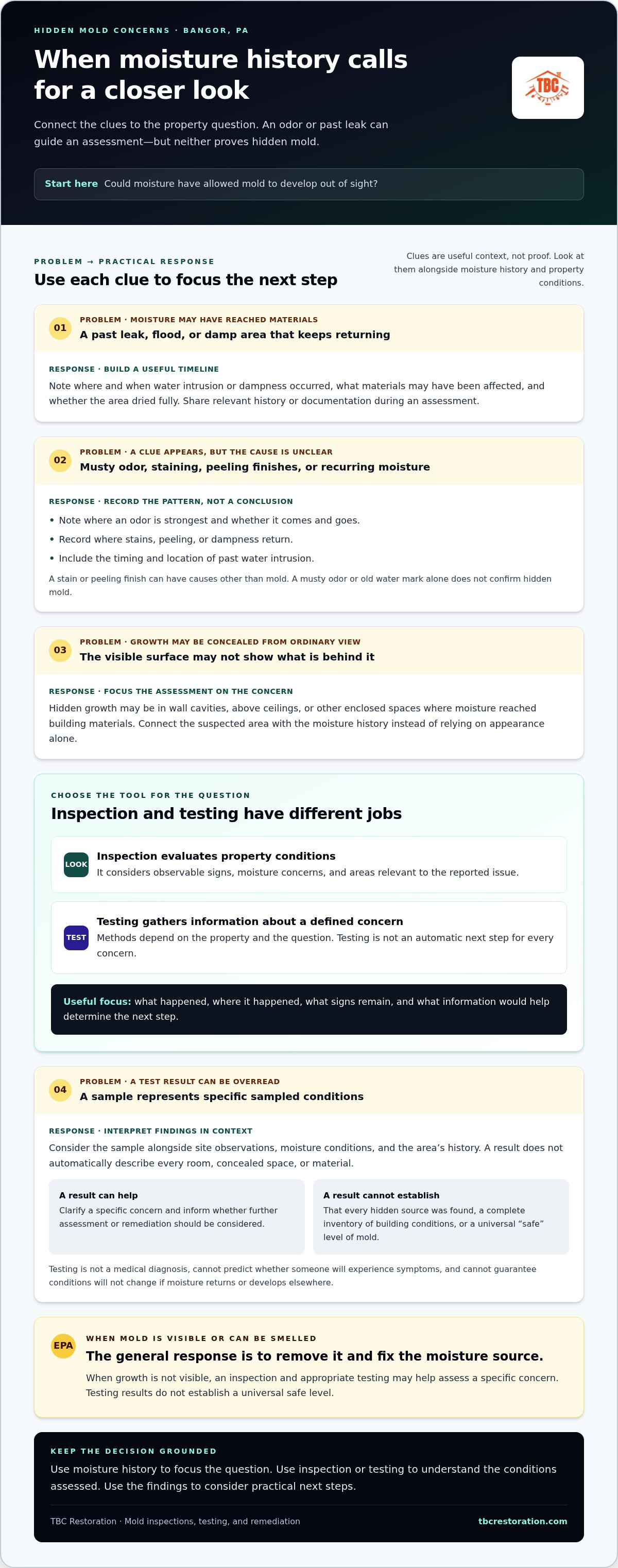
What if a musty smell is coming from somewhere you can’t see? A visual check may reveal surface growth, but it can’t show what is behind drywall, under flooring, or inside other building materials. If you’re considering hidden mold testing Bangor PA, start with the question you need answered: could moisture have allowed mold to develop out of sight?
A past leak, persistent dampness, or unexplained odor can raise reasonable concerns, especially in a basement or another moisture-prone area. Testing isn’t always necessary: the EPA says that when mold is visible or can be smelled, the response is generally to remove it and fix the moisture source. When growth isn’t visible, an inspection and appropriate testing may help assess a specific concern. Results can’t establish a universal “safe” level of mold.
This guide explains when hidden mold testing may help, what an inspection or test can and can’t tell you, and how to choose a practical next step. TBC Restoration provides mold inspections, testing, and remediation for Bangor and nearby communities, helping property owners understand findings and plan a response.
Table of Contents
Hidden Mold Testing in Bangor, PA: When a Concern Calls for a Closer Look
Suspecting mold without seeing growth can leave you unsure what to do next. A musty smell, a history of water intrusion, or a damp area that keeps returning can justify a closer look, but none proves mold is present. Start by connecting what you’ve noticed with the property’s moisture history, then identify what you want an assessment to clarify.
Hidden mold is growth concealed from ordinary view within or behind building materials. It may be out of sight in an enclosed area, but that possibility alone isn’t a diagnosis. General information about Understanding Mold can provide background. Deciding whether a specific property needs inspection or testing requires attention to its own conditions.
Consider what happened before the concern appeared. A roof leak, flooding, a plumbing leak, or persistent dampness may leave moisture in or around materials even after visible water is gone. If an odor or damp spot returns, record where and when it happens. That timeline can help focus an assessment. Don’t assume a particular cause before the affected area is evaluated.
What property clues can make hidden mold worth investigating?
Clues are useful as context, not proof. A recurring musty odor may give you a reason to investigate. Staining, peeling finishes, or recurring moisture can help identify where to look more closely. A past leak or flood adds useful history, especially if you don’t know which materials became wet or whether the area dried fully.
Note where an odor is strongest and whether it comes and goes.
Record locations where stains, peeling, or dampness return.
Share the timing and location of past leaks, flooding, or other water intrusion.
These observations describe the concern without treating any single clue as a mold test. If there’s a visible moisture problem, document it and include it in the assessment.
Where can mold remain out of sight?
Concealed growth may be present in wall cavities, above ceilings, or in other enclosed spaces where moisture has reached building materials. The surface you can see may look intact even when the material behind it has been affected. Conversely, a stain or peeling finish can have causes other than mold. A closer assessment connects visible conditions with the area’s moisture history instead of relying on appearance alone.
For hidden mold testing Bangor PA, focus on the specific uncertainty: where moisture may have traveled, whether signs keep returning, and what information would help determine the next step. A musty odor or old water mark deserves attention when paired with relevant moisture history, but neither confirms hidden mold on its own. A focused assessment can clarify the concern without jumping to conclusions about the property.
How Hidden Mold Inspection and Testing Can Clarify a Bangor Property Concern
Inspection and testing serve related but distinct purposes. An inspection assesses property conditions, including visible signs, moisture concerns, and areas relevant to the reported issue. Testing collects information to help answer a defined question. Testing isn’t an automatic next step for every concern. The appropriate approach depends on the property and what needs clarification.
A visual inspection evaluates observable conditions; a test gathers information from specific sampled conditions. Neither should be treated as a promise that every concealed area has been checked. For example, after a leak, an inspection may help focus attention on the affected part of a room, while testing may provide additional information about a particular concern there. The purpose is to guide a decision, not to claim certainty beyond what was assessed.
What questions can mold testing help answer?
Testing is most useful when tied to a clear question, such as whether a specific area may have mold-related conditions following a moisture event. The concern might involve one room or a particular section of a building rather than the entire property. Explaining what happened, where it happened, and what signs remain gives an assessment a practical focus.
Methods depend on the property and the question being asked. There isn’t one approach that should be assumed for every situation. Findings may help determine whether more assessment is appropriate or whether remediation should be considered. They can’t guarantee discovery of every hidden source or create a complete inventory of all conditions in a building.
What can a mold test not establish by itself?
A test result describes the conditions represented by the sample or samples collected. It doesn’t automatically describe every room, concealed space, or material in the property. Results need to be interpreted alongside site observations, moisture conditions, and the history of the area. The EPA Mold Guidelines offer general information about mold and related concerns, but a result from one property should be understood in its own context.
Testing also isn’t a medical diagnosis, and it can’t predict whether someone will experience symptoms. Nor can it guarantee that conditions won’t change if moisture returns or develops elsewhere. If a result seems confusing, connect it back to the original question: what area was assessed, what conditions were observed, and what does the finding suggest as a practical next step?
That distinction matters before deciding on remediation. A finding may support further evaluation or a response to an identified condition, but the result alone shouldn’t be treated as a complete scope of work. TBC Restoration’s mold inspections and testing help property owners in Bangor assess a specific concern and understand findings in relation to observed conditions. Learn about TBC Restoration’s mold testing.
Hidden Mold Testing vs. Visible Clues: Choosing the Right Next Step
Visible clues, moisture history, and testing answer different questions. A stain or peeling finish shows where a surface has changed, but it doesn’t confirm mold. A record of a leak or recurring dampness helps explain where moisture may have traveled. An assessment can connect those details to the property, while testing may add information when a specific concern remains. Testing is a tool, not an automatic requirement.
Start by documenting what you can observe. Note where a smell or dampness occurs, when it appears, and whether it returns. Photos and records of past water events can help establish a useful timeline. This information supports a focused assessment instead of relying on one clue as proof or guessing what may be behind a finished surface.
Observation: What is visible or noticeable now, and where?
Moisture history: What areas were affected by a leak, flooding, or ongoing dampness?
Assessment: What conditions can be evaluated at the property?
Testing: What specific question could collected information help address?
This distinction can be useful during a home purchase or sale, too. If moisture or suspected mold is part of the discussion, a clear written record of observations and assessment findings can help everyone understand what was reviewed and what remains uncertain. Keep the scope clear: a written summary of one area isn’t proof about unassessed parts of the property.
When are visible clues enough to request an assessment?
A past leak, recurring dampness, or persistent odor can be enough to explain why you want an assessment, even though none confirms mold by itself. A concern deserves closer attention if it keeps returning or seems to involve an enclosed area. Describe the location and timing, and share relevant records. Don’t open walls or disturb suspected material to investigate. Let the assessment guide an appropriate next step.
When can testing add useful information?
Testing may help when an assessment leaves a specific concealed-area question unanswered, such as whether an area affected by moisture needs further attention. Findings can contribute to a more informed decision about whether additional evaluation or remediation is appropriate. Interpret them alongside observations and moisture history, not in isolation. For hidden mold testing Bangor PA, choose the next step that addresses the property’s defined concern, whether that calls for observation, assessment, testing, or a combination.
There’s no need to assume that every musty odor or mark calls for sampling. If mold is visible or can be smelled, the U.S. Environmental Protection Agency says testing is often unnecessary because the response is generally to remove the mold and correct the moisture problem. A focused evaluation can help determine which situation you’re facing and keep the response proportionate to the evidence.
How to Prepare for Hidden Mold Testing in Bangor, PA
A little preparation can make an assessment more focused. You don’t need to identify the cause or decide whether mold is present beforehand. Collect what you’ve observed, note where and when it happens, and share relevant history. For hidden mold testing Bangor PA, clear information about the concern helps keep the assessment centered on the question you want answered.
What information should you gather beforehand?
Make a simple record of what you’ve noticed. Include the location and timing of odors, stains, leaks, or recurring dampness. If you have records of previous water events, drying work, or repairs, gather those too. The goal is to share the sequence of events accurately, without deciding in advance what caused the signs.
Identify the areas of concern. List the room or location where you noticed an odor, staining, dampness, or another change. If the concern appears in more than one place, note each area separately.
Record when you noticed it. Write down when a sign first appeared, whether it has returned, and whether it changes over time. Approximate dates are helpful if exact ones aren’t available.
Gather relevant property history. Collect information about past leaks, flooding, drying work, repairs, or other moisture events. Include only what you know. Don’t assume a repair or event explains the current concern.
Prepare your questions. Note what you want clarified, such as whether a specific area needs further assessment or what findings could mean for next steps.
The most useful information to share is the location of the concern, when it appeared, and the property’s moisture history. Photos or repair documents can add context, but they don’t replace a clear description in your own words. If you’re unsure about a detail, say so rather than guessing at a cause.
How should you understand the findings?
Review findings in relation to the concern that led to the assessment. Consider which areas were observed or tested, what property conditions were noted, and what question the information addresses. Findings relate to the scope of the assessment, so they shouldn’t automatically be treated as a complete account of every space or condition in the building.
The appropriate next step depends on what the assessment shows. It may involve further evaluation, correcting a moisture condition, or considering remediation. TBC Restoration’s Mold Remediation and Testing includes inspection, testing, containment, removal, and antimicrobial treatments. A clear record of the concern and findings can help make that transition more informed.
For help understanding the process and planning a practical response, learn how TBC Restoration approaches mold testing and remediation.
From Hidden Mold Testing to Remediation: TBC Restoration’s Local Next Steps
Once you’ve identified a concern, follow a clear process: describe what you’ve noticed, assess the property, use testing when it helps answer a specific question, review the findings, and decide what should happen next. This keeps the response tied to observed conditions instead of assuming testing will find mold or that every concern requires the same work.
For hidden mold testing Bangor PA, assessment and testing are part of a broader service path. Findings can help clarify which areas need attention and whether further assessment or remediation is appropriate. They inform decisions, but they don’t guarantee that every concealed condition has been identified or that future moisture concerns won’t occur.
How can testing findings guide mold remediation?
Testing information is most useful when considered alongside the inspection and the property’s moisture history. If findings support remediation, they can help inform a response suited to the concern. TBC Restoration’s Mold Remediation and Testing includes inspections, testing, containment, removal, and antimicrobial treatments. These are service elements, not a promise that testing will always detect mold or that remediation will prevent every future issue.
TBC Restoration provides certified mold remediation and uses eco-friendly solutions. The goal is to help property owners understand the concern and available next steps, with decisions grounded in the assessment rather than assumptions. Where moisture remains an issue, addressing the conditions that contribute to it is also an important part of planning a practical response.
What makes TBC Restoration a local resource for Bangor?
TBC Restoration serves Bangor and nearby communities, bringing local restoration experience to property concerns that can feel uncertain. Established in 2020, the company provides mold inspections, testing, and remediation, connecting assessment findings with services such as containment and removal. Its focus is a clear, careful process and dependable restoration support, not alarmist conclusions.
TBC Restoration provides mold removal and antimicrobial treatments, with the response guided by the conditions identified. For urgent property emergencies, the company provides emergency restoration services 24/7.
Local property owners in Bangor, Stroudsburg, East Stroudsburg, Marshall’s Creek, Bushkill, Crescent, Mount Pocono, Bangor, Tannersville, Snydersville, and Saylorsburg can share what they’ve observed and use the findings to choose a practical next step. For help with a mold concern, contact TBC Restoration.
Take the Next Step With Clarity
Uncertainty can make a property concern feel larger than it is. You don’t need to reach a conclusion on your own or make decisions based on a smell, mark, or worry alone. Treat the concern as a starting point: describe what prompted it, consider what information would help, and use a focused assessment to guide what comes next.
For hidden mold testing Bangor PA, a practical next step addresses the specific question you still have about your property. Keep relevant notes together as you move forward, and take the process one decision at a time. Clear information can help replace guesswork with a steadier plan.
Talk with TBC Restoration about hidden mold testing in Bangor and discuss a practical path forward for your property.
Frequently Asked Questions
Can hidden mold be present without visible spots?
Yes, mold can be present without spots on visible surfaces, especially if it’s concealed within or behind building materials. A musty odor, staining, or a past leak can help identify where to look, but none confirms mold by itself. Keep a dated note of what you notice and where it occurs. For hidden mold testing Bangor PA, an assessment can help determine whether testing may add useful information.
How do professionals test for hidden mold?
Professionals choose an approach based on the concern, property conditions, and areas that need evaluation. There isn’t one method suited to every situation. A reported leak behind a finished surface raises a different question from visible staining in an accessible room. An assessment helps define the issue, and testing may add information when appropriate. Findings relate to the area examined, not the entire property.
Is mold testing necessary if I can already see mold?
Not always. The U.S. Environmental Protection Agency says testing is often unnecessary when mold is visible or can be smelled, because the general response is to remove it and fix the moisture problem. A professional assessment can help determine whether a separate question, such as a concern about a concealed area, makes testing useful. Avoid disturbing suspected material yourself, and share any signs of ongoing moisture during the assessment.
Can a home inspection find mold behind walls?
A standard visual home inspection may not identify conditions hidden behind walls or ceilings because those areas aren’t visible during an ordinary walkthrough. A home inspection and a focused mold assessment serve different purposes. If you’re buying a property and notice a history of leaks or dampness, document the location and include the concern in your assessment rather than relying on a surface-level observation to understand the area.
What should I do if a mold test finds a problem?
How much does hidden mold testing cost in Bangor, PA?
The assessment scope depends on the property and the question being investigated. A concern limited to one area can require a different assessment from one involving several locations or recurring moisture. Make a note of where the concern is, what you’ve observed, and any relevant water or repair history so the scope can be discussed in context.
Does TBC Restoration provide mold testing and remediation near Bangor?
Yes. TBC Restoration provides mold testing and remediation for Bangor and nearby communities. Its local service area includes Stroudsburg, East Stroudsburg, Marshall’s Creek, Bushkill, Crescent, Mount Pocono, Tannersville, Snydersville, and Saylorsburg. Share the affected area and relevant property history to make the concern clear and keep the discussion focused on practical next steps.
Can a mold test tell me whether my symptoms are caused by mold?
No. A property test provides information about sampled conditions. It can’t diagnose a person or establish the cause of symptoms. If you’re experiencing health concerns, speak with a healthcare professional who can consider your individual situation. For the property, an assessment can help clarify whether the reported conditions warrant further investigation or remediation. Keep health questions and property findings distinct when deciding what steps to take.
Comments